

The envelope said only “A&E.” Maeve Flynn had taken her son Brian to get a new pair of prescription sunglasses.
He was looking forward to a holiday in Spain with his close friends. But instead of a new prescription, Brian had instructions to get to A&E as soon as possible. His eye exam showed a problem. It might turn out to be nothing, but best to get it checked, right away. They were in Limerick, so they headed to Limerick University Hospital. At the hospital, the tests showed nothing. But they had to wait overnight for a CT scan.
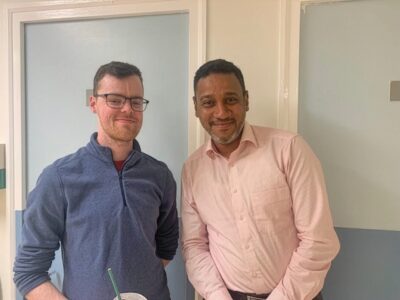
The scan showed that Brian, only 20 and in his third year at university, had a brain tumour, a meningioma. A very large one. Brian was transferred to Cork University Hospital, a centre of excellence for neurosurgery. And that’s where he and his family met neurosurgeon Wail Mohammed.
The beginning of a very special friendship….
“We were so lucky that day,” Maeve Flynn says. “Right from the start, Wail was involved. And from the first minute we met him, we knew.” Brian, who was studying environmental science, found he could ask the surgeon anything. Wail said he learned from Brian’s constant queries. Unfortunately, what they learned wasn’t happy news.
The tumour was too big and too vascular to operate. But he told Brian he might live a long time with it. And he didn’t stop there. “Look, we will search for answers.” He sent Brian’s files all over the world. For Brian’s parents, it was difficult news to accept. “Brian had never been sick. He had no symptoms whatsoever.”
In the end, experts from around the world agreed: don’t touch it. All they could do now was treat his symptoms. A lasting bond is born of kindness
and trust. You might think that the neurosurgeon would become less involved at this point. But Wail and Brian had bonded. Even on his days off, Wail would come in to check on Brian and have a chat. They’d talk football. Brian would ask questions about his condition. And he’d pass along more questions from his
brother James, another scientist, and his sister Jennifer. Maeve and Richard remember seeing a man coming down the hall in jeans one day. Maeve asked Wail: “Aren’t you off today? Why are you here?” It was his day off. But he’d come in to check on Brian. In the meantime, Brian was busy endearing himself to everyone in the hospital. “He didn’t think he was the sick one,” Maeve says. “He’d get out of bed and help everyone else. He’d pass someone their slippers or give them their walker.” The nurses adored him.
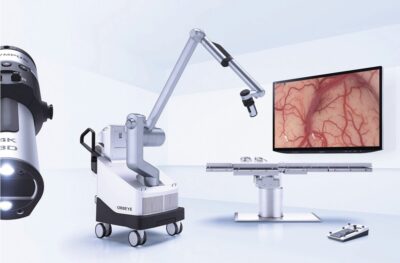
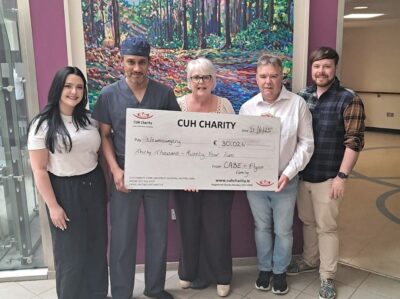
A life remembered, and extraordinary commitment honoured. The family decided that CUH would be their charity. They shared the news with Wail and asked what equipment he’d need in surgery. Brian told him they’d get it for them. Wail told them about the Orbeye Exoscope. But he also told them the cost: half a million at least.
The Flynn’s weren’t deterred. They pushed ahead. And that’s why we’re asking you to help today. To date, they have raised €58,000. Would you help match their gift? Brian’s sight was going, his walk, everything. He needed major brain surgery, despite the risks. Brian had never complained about his situation and didn’t even then. He knew his chance of surviving was 50-50. Brian asked Wail to be part of the surgery team, and he agreed. But as Wail was visiting his father in Sudan, the surgery was scheduled. Wail rushed back… but didn’t make it in time. He was crushed. Brian survived just long enough for his family to say goodbye.
Later, Maeve and Richard Flynn told Wail they were glad he hadn’t been there.
They knew how painful it would have been for him. Brian’s parents told us how grateful they are for Brian’s care. “The genuine care he got, not only the nurses, but the neurology staff… who did so much research to try to find an answer. Brian had the whole hospital behind him.” Wail stays in touch with Brian’s family.
He says, “Neurosurgeons don’t like to see complications. But it was different with him. Every time I saw him, I saw someone I wanted to help but couldn’t. And he accepted that.”
“He was so young, to be so kind, wise, and accepting.”
You can honour Brian’s memory by making a donation to Neurosciences today in honour of this incredible young man.
Your contribution, of whatever size you feel is right, will help countless people in the future!
Real Donations at Work, We Purchased the Orbeye Exoscope:
When performing neurosurgery, navigation and magnification are key. The smaller the incision needed, the better for the patient. But surgeons had to look through an eyepiece, such as a microscope. That meant the surgeon had to move around the patient, often in difficult positions.
Now, instead of a looking down the eyepiece as with a microscope, the exoscope broadcasts the image onto a large screen. That’s better for surgeons and for patients.